
Lenzing steps up circularity with LENZING™ ECOVERO™ fibers with REFIBRA™ technology
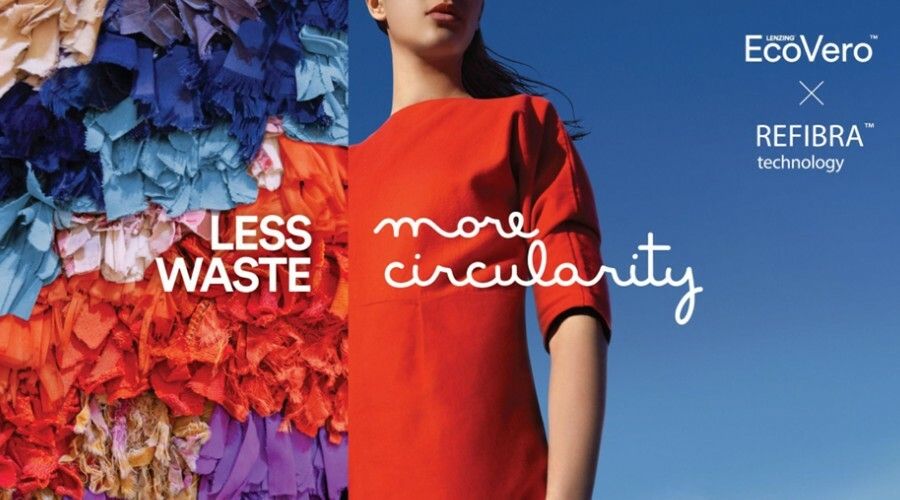
The textile industry is undergoing a profound shift, with recycling emerging as a driving force for change. As a trailblazer in eco-conscious textile solutions, Lenzing’s specialty LENZING™ ECOVERO™ fibers with REFIBRA™ technology incorporate recycled cotton textile waste, showcasing Lenzing’s commitment towards circularity in action.
We sat down with Jayaraman Sethuraman, Vice President of Global Sales Textiles, and Krishna Manda, Vice President Corporate Sustainability at Lenzing to explore this pioneering textile-waste recycling approach and its pivotal role in Lenzing’s circular strategy.
Q: Lenzing has been continuously introducing innovations and partnerships, could you tell us about what Lenzing has achieved with LENZING™ ECOVERO™ with REFIBRA™ technology?
Jayaraman: When people hear "recycling," they probably picture stacks of paper or mountains of plastic bottles. Here at Lenzing, we strive to take this one step further by making textile recycling, including post-consumer textiles, just as common as the other forms of recycling.
Last September, we achieved an important breakthrough in expanding our specialty REFIBRA™ technology to LENZING™ ECOVERO™ Viscose fibers which are derived from controlled or certified wood sources [1] and are EU Ecolabel certified [2]. These fibers produced with REFIBRA™ technology use textile waste as a raw material, in addition to wood. The fibers contain a minimum of 20% recycled material, which is sourced from pre- and post-consumer textile waste. LENZING™ ECOVERO™ fibers with REFIBRA™ technology also support fabric softness and drape, which are preferred fiber qualities of fashion and textile brands.
This is an exciting milestone because adapting recycled pulp for large-scale industrial fiber production has always been a challenge to the industry. I am proud to say that despite the persisting hurdles, we have been able to make LENZING™ ECOVERO™ with REFIBRA™ technology available to customers worldwide. In fact, one of our longstanding partners, New Focus Textiles, has already used LENZING™ ECOVERO™ with REFIBRA™ technology in their collection with novelty yarn patterns and fabrics.
Q: With climate change being a pressing global issue, the focus on circularity has become increasingly urgent. How is LENZING™ ECOVERO™ with REFIBRA™ technology helping the industry resolve this need?
Krishna: With circularity at the heart of our growth strategy, we are committed to giving waste a second life and helping our customers transition to a circular future. [3] [4]
At its core, the REFIBRA™ technology transforms scrap materials into new recycled fibers, preventing them from ending up in landfills. The pre- and post-consumer cotton textile waste utilized is collected and sorted in collaboration with industry partners who take part in pre- and post-consumer textile recycling programs. This innovative approach not only builds upon the highly efficient production processes of standard LENZING™ ECOVERO™ fibers but also reduces reliance on virgin raw materials.
We also made sure that our LENZING™ ECOVERO™ fibers produced with REFIBRA™ technology met the rigorous Recycled Claim Standard, which traces and verifies recycled inputs from source to store [5]. By marrying the renewable nature of wood with the circularity of recycled materials, we have created a fiber that represents a remarkable leap towards greater circularity without compromising on quality, which we believe has the potential to revolutionize the textile industry.
Q: In recent years, consumers have become increasingly conscious about their purchasing decisions, how does LENZING™ ECOVERO™ with REFIBRA™ technology meet their needs and expectations?
Jayaraman: Today's eco-conscious consumers care a lot about where their clothes come from, how they're made, and their impact on the planet. It's not just about looking good anymore; they want to feel good too, knowing they're making well-informed choices.
At Lenzing, we understand that authenticity and transparency are essential for building trust and enabling true circularity. This is why we made our LENZING™ ECOVERO™ fibers with REFIBRA™ technology identifiable via tracing technology [6], from the wood source to the final garment. We also comprehensively detail our fiber credentials on our website, aligned with the latest EU Green Claims requirements, to provide our partners with greater peace of mind stemming from fact-based information. By championing transparency as a norm, we strive to foster an open and collaborative culture across the textile value chain.
Q: Looking ahead, what are some of the key areas that Lenzing plans to focus on to further drive circularity throughout the business and the industry? What action is needed from industry partners and consumers?
Krishna: From exploring resource-efficient production methods and reducing carbon emissions [7] at our pulp mills to safeguarding raw material security [8] and biodiversity [9], Lenzing is fully dedicated to driving circularity throughout the fiber production process. It’s important to remember that we’re not doing it alone - we're proactively partnering with industry leaders to facilitate systemic change.
Our enthusiasm grows each day as we reflect on the great progress we have already made. For example, this year we pioneered the application of a waterless dyeing technology on cellulose fibers in partnership with Exponent Envirotech [10]. We also successfully cut our absolute greenhouse gas emissions scope 1, 2 and 3 by 19 percent since 2021 and specific sulfur emissions to air by more than half since 2014 [11]. Furthermore, we successfully increased the conservation area at our pulp mills [12] and signed supply agreements that include sustainability clauses with our top chemical suppliers. That being said, we know that there is still work to be done, and the support of our consumers and partners is a vital part of the solution. With our brand partners’ and retail customers’ pledges encouraging demand for product collections made with recycled fibers, we can drive circularity together.
By integrating recycled and renewable materials like LENZING™ ECOVERO™ with REFIBRA™ technology into their products, industry players can help set a new standard for circularity. By choosing brands that demonstrate a genuine commitment to circularity, consumers can also play a part in fueling the movement for a better future. Every product purchased with consideration for the planet is a vote for the world
[1] https://www.lenzing.com/sustainability/production/resources/wood-and-dissolving-wood-pulp
[2] EU Ecolabel for textile products (license no. AT/016/001).
[3] To foster a sustainable global textile and nonwovens industry, Lenzing follows three strategic principles within the context of its “Naturally Positive” sustainability strategy, which focuses on greening the value chain, advancing the circular economy, and collaborating for systemic change with key industry stakeholders, such as Textile Exchange, Cascale, Canopy, Together for Sustainability, Renewable Carbon Initiative, and UN Global Compact.
[4] Lenzing – Focus Paper on Sustainability Strategy “Naturally Positive”, April 2024
[5] https://textileexchange.org/recycled-claim-global-recycled-standard/
[6] LENZING™ ECOVERO™ fibers with REFIBRA™ technology are produced with a molecular marker. This special identification technology ensures the authenticity and traceability of LENZING™ ECOVERO™ fibers even after processing into textile products.
[7] LENZING™ ECOVERO™ Viscose fibers are made with at least 50% less carbon emissions and water consumption, compared to generic (unbranded) viscose. The results were calculated according to LCA standards (ISO 14040/44) and are made available via the Higg Materials Sustainability Index (MSI) v3.7 by Cascale (formerly Sustainable Apparel Coalition).
[8] Adhering to the company’s commitment to environmental protection and resource preservation, Lenzing procures wood and pulp only from certified or controlled sustainable sources. In its Wood and Pulp Policy, Lenzing is committed to procuring wood and pulp exclusively from non-controversial sources.
[9] Lenzing – Focus Paper on Biodiversity and Ecosystems, April 2024
[10] Lenzing partnered with technology start-up Exponent Envirotech to introduce ECOHUES™, a waterless dyeing technology to Lenzing’s cellulosic fibers. ECOHUES™ technology effectively replaces the use of water in the dyeing process with a non-aqueous solvent that is 99.8% reusable and streamlines the pre-treatment and finishing processes by nearly removing the need for soap washing after dyeing. This helps to reduce the overall water usage by 95% compared to traditional dyeing methods.
[11] Lenzing – Annual and Sustainability Report 2023
[12] Lenzing increased the protected area at the site in Indianópolis (Brazil) from 13,000 ha to 19,000 ha in 2023.